
Quick answer: Does motorcycle insurance cover off-pavement adventure riding?
Most standard motorcycle policies cover dual-sport and ADV riding on public dirt roads, but exclude closed-course, competition, and some designated OHV areas. Add accessory coverage for luggage, crash bars, and navigation, plus personal effects and roadside towing with mileage limits that reach remote Southern Utah trailheads.
In this article8 sections
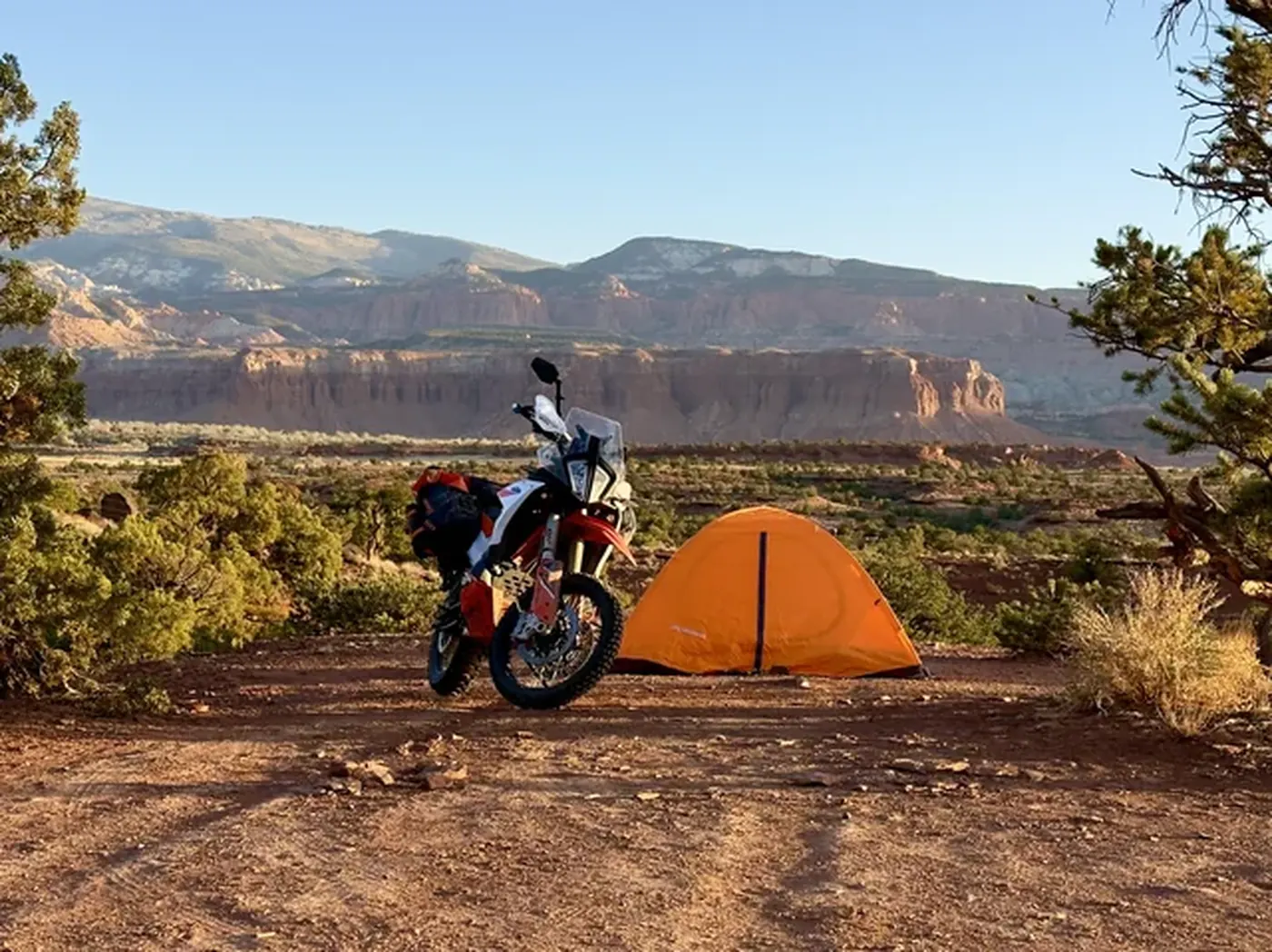
Adventure riding is booming in Southern Utah. The same BLM roads, Forest Service two-tracks, and dispersed campsites that pull in overlanders are now full of KTM 890s, Tenere 700s, Africa Twins, and the occasional Honda Trail 125 loaded down with a week of gear. If you're riding the White Rim, Hole-in-the-Rock Road, the Swell, or just stringing together free campsites between St. George and Moab, your insurance needs a quick gut-check before the trip, not after.
What "off-pavement" actually means to your insurance carrier
The good news: every standard motorcycle policy we write in Utah covers normal dirt-and-gravel road use. BLM two-track, Forest Service roads, ranch roads, the dirt sections of the Utah Backcountry Discovery Route, all of that is treated the same as paved riding for liability, comprehensive, and collision purposes. You don't need a special endorsement to legally and safely insure an ADV bike that spends half its life on gravel.
The exclusions kick in when you cross into competitive or organized off-road events: enduros, hare scrambles, hill climbs, motocross, and any "speed contest." Most policies also exclude use inside a dedicated motorsports park. If that's part of your riding, you need either an off-road endorsement or a separate OHV policy alongside your street coverage. Our ATV / off-road insurance page covers the OHV side.
Theft at remote trailheads and dispersed campsites
Comprehensive coverage on a motorcycle policy doesn't care where the bike is parked. If it's stolen out of a dispersed site near Capitol Reef, off the road into Lockhart Basin, or from a BLM trailhead at the edge of the Grand Staircase, your comp claim works the same as if it were stolen from your driveway in our St. George, Utah insurance page. What changes is the practical risk: an unlocked bike five miles down a sand wash is an easier target than one in your garage. A disc lock and a hidden GPS tracker (Monimoto, AirTag) cost less than your comp deductible and pay for themselves on the first close call.
Camping gear, electronics, and the personal effects gap
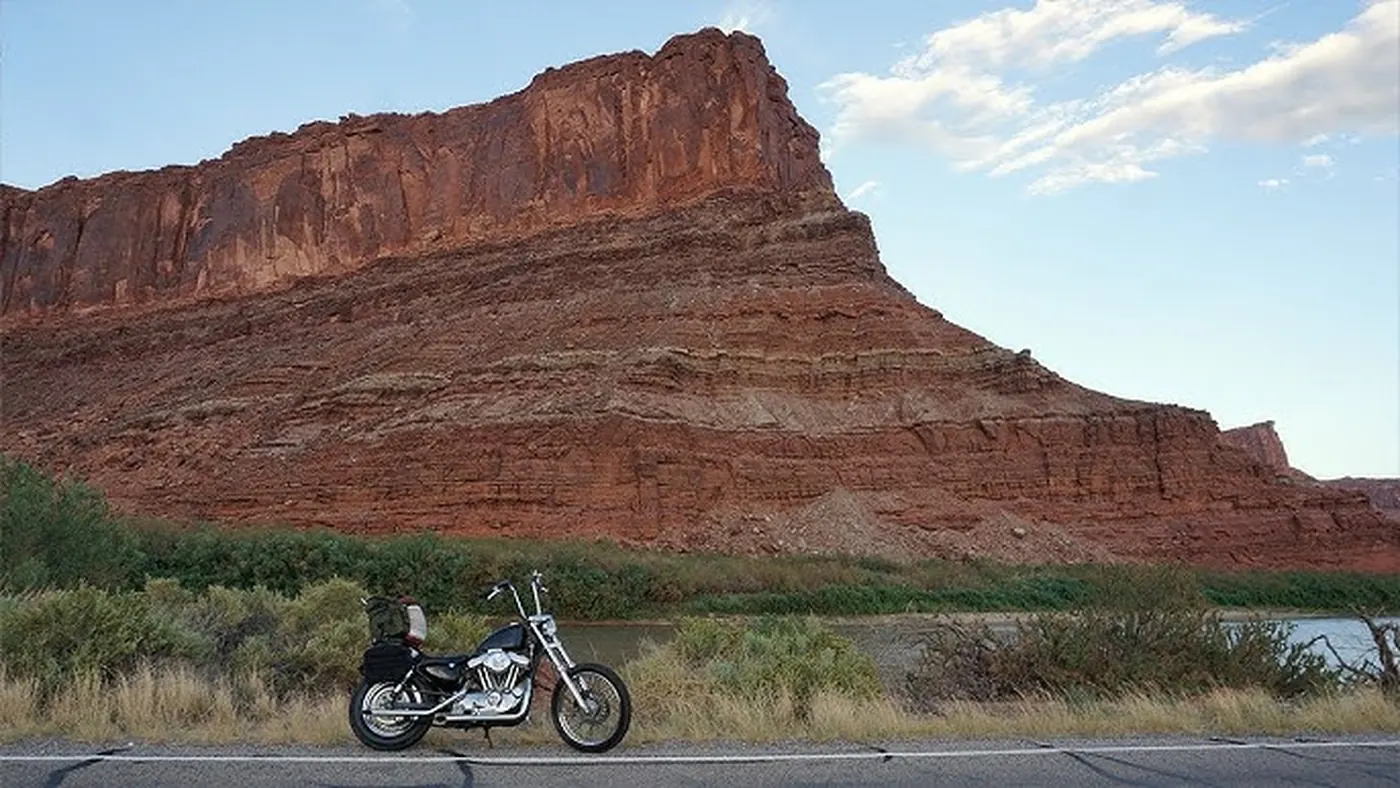
This is where almost every adventure rider is under-insured. A loaded ADV bike on a 10-day trip is carrying $3,000 to $10,000 of gear: tent, sleeping system, satellite communicator, camera, drone, laptop, cooking kit, riding gear, tools, spare tires. Almost none of that is covered by a base motorcycle policy, and your Southern Utah homeowners policy typically caps off-premises personal property at 10% of contents with low sub-limits on electronics.
Two ways to fix it:
- Personal effects / rider apparel endorsement on the motorcycle policy, usually $1,000 to $5,000 of coverage for $5 to $15/month. Covers gear damaged in a crash, fire, or theft from the bike.
- Scheduled personal property on your homeowners or renters policy, best for high-value items (Leica camera, MacBook, Garmin inReach Mini) where you want agreed value and no deductible.
Dual-sport, dual-registered, or off-road only?
Utah lets you register some dirt bikes as both street-legal (with a plate) and OHV (with a sticker). The way you insure the bike matters:
- Street-plated only: motorcycle policy. Full liability and physical damage on the road and on legal dirt roads.
- OHV-stickered only: ATV/OHV policy. Cheaper, but no road coverage, and significantly lower liability limits by default.
- Dual-registered: almost always a motorcycle policy. Higher liability limits protect you on the highway sections that connect your trails, and comprehensive still covers theft off the trailer or out of the garage.
If your insurance currently has the bike on an ATV policy and you ride it on the road between trail sections, call us. That's a coverage gap waiting to bite.
MedPay, UM/UIM, and the cell-service problem
Half the appeal of riding Southern Utah is that you can disappear off the grid for a day. The downside is that an at-fault driver on Highway 12, Notom Road, or the Burr Trail might not have insurance, and your ride out is two hours by truck, four by ambulance, or a helicopter you don't want to pay for out of pocket.
Three things every adventure rider should carry:
- MedPay $25,000+: pays your medical deductibles, copays, and air-ambulance gaps regardless of fault.
- Higher UM/UIM limits: covers you when the at-fault driver is uninsured or underinsured. Utah's roughly 1-in-11 uninsured rate is even higher on rural highways. Ask a licensed agent what limits make sense for your situation.
- Medical evacuation membership: Global Rescue, MedjetAssist, or Garmin inReach with an SOS plan. Not insurance, but a $150/year membership against a $30,000 helicopter bill.
Trailering, support vehicles, and tow rigs
Most adventure trips involve a truck or van as basecamp. A few things to confirm:
- Your motorcycle policy follows the bike on the trailer, but the trailer itself needs to be scheduled either on the auto or motorcycle policy.
- If you carry the bike in the bed of a truck, your Utah auto insurance policy's comprehensive covers the bed but not the bike, that stays on the motorcycle policy.
- Sprinter vans and toy haulers used as part-time lodging fall under RV coverage rules, see our RV insurance guide.
Riding out of state on a Utah policy
Crossing into Arizona for the Arizona Peace Trail, into Nevada for the Nevada BDR, or into Colorado for the COBDR is all fully covered under your Utah motorcycle policy. Liability automatically adjusts to meet each state's minimums; your higher limits stay in place. The one exception: if you're spending more than ~6 months a year out of state, the policy needs to be rewritten in your new home state.
Before the next trip
- Pull up your dec page and review your current liability and UM/UIM limits with a licensed agent to see whether they still fit your situation.
- Confirm MedPay is $10,000+ (we default to $25,000 for adventure riders).
- Add or increase the personal effects / rider apparel endorsement to match what's actually strapped to the bike.
- Schedule any item over $1,500 explicitly, cameras, drones, satellite comms, premium tents.
- Save your agent's number and your policy number offline (notes app, not just email) in case you lose cell service.
Heading out for a week on the Zion-to-Bryce loop or a longer push up the UTBDR? Get a fresh motorcycle quote or call our St. George office before you load the panniers. Five minutes now is cheaper than every recovery story we've heard.
Frequently asked questions
Does motorcycle insurance cover off-road riding in Utah?
Is my bike covered if it's stolen from a backcountry campsite?
Do I need separate insurance for a dual-sport like a KTM 690 or DRZ400?
This article is for general information only and isn't a substitute for professional insurance advice. Coverage terms, limits, and exclusions vary by policy and carrier. Talk to a licensed agent before making coverage decisions.
Kip Lee is co-founder of OnPoint Insurance Group in St. George, a Utah-licensed insurance agent (Utah Lic. #224633, NPN 8433982) serving Southern Utah riders and households since 2005.
Want this dialed in for your situation?
Free, no-pressure quote from a local Southern Utah agent.